
When the Seed Becomes Root and Hope: Mapuche‑Lafkenche Women Create a Community Hazelnut Oil Laboratory
This article was originally published in Spanish by the Fund for the Development of Indigenous Peoples of Latin America and the Caribbean (FILAC). It has been translated into English by MAPLE Microdevelopment for educational and non‑commercial purposes, with full respect for the original authorship and community voices. Photographs included are shared courtesy of MAPLE Microdevelopment and the Agrupación Rekvlvwvn ka Kelluwvn community network. The original Spanish version is available here: FILAC
When the Seed Becomes Root and Hope: Mapuche‑Lafkenche Women Create a Community Hazelnut Oil Laboratory
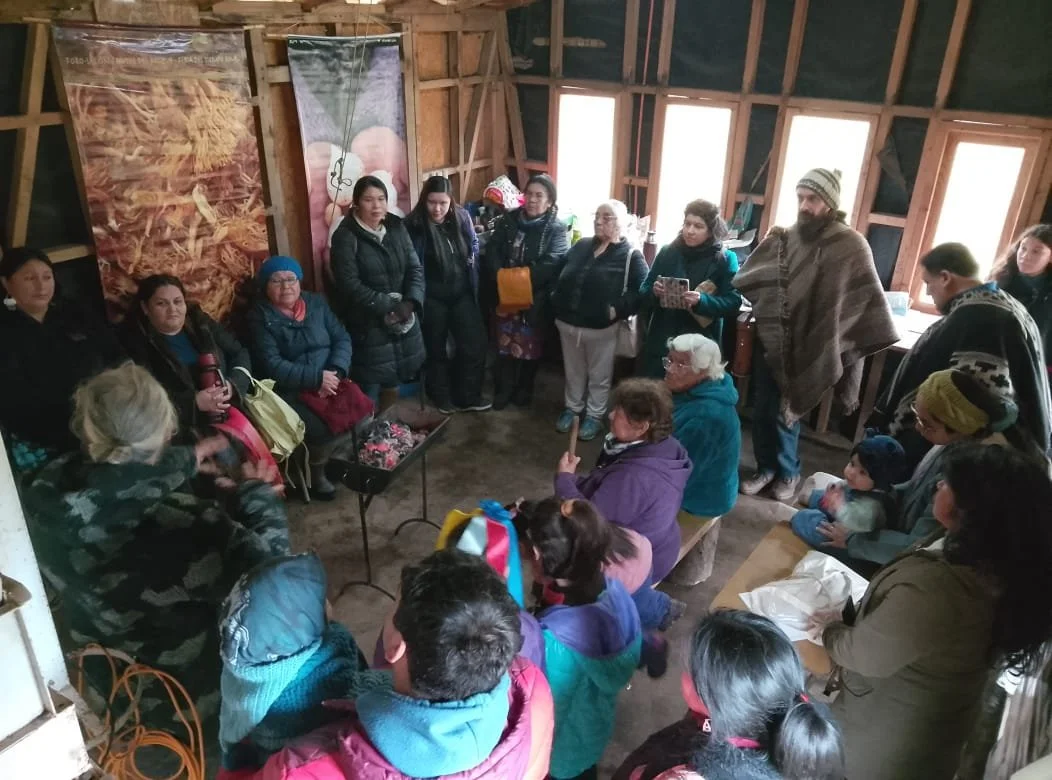
CHILE, Sept. 16 2026 (FILAC) – Along the shores of Lake Budi, in Chile’s Araucanía Region, Mapuche-Lafkenche communities have brought to life a community hazelnut oil laboratory. This initiative seeks not only to restore the biodiversity of the territory, but also to strengthen the economic empowerment of Mapuche women through a circular economy that combines the sustainable use of natural resources with the protection and revitalization of the biocultural heritage of Lake Budi
The laboratory places Indigenous women at the center of the process. “The gathering tradition comes from our mothers and grandmothers, who knew how to make use of the diversity of fruits offered by the forest. This work seeks to recognize that role and support women heads of household, our daughters and sons, in contributing to the economic well-being of families,” explains Elizabeth Curiqueo, coordinator of the initiative.
In this way, the project promotes an economy grounded in respect for and protection of Itxofilmogen — life in all its diversity — encouraging a sustainable balance between community well-being and the natural environment.
For Elizabeth, the laboratory is not only a productive alternative, but also an act of memory and reciprocity with nature: “Our parents and grandparents taught us to gather only what was necessary, because we were never alone in the forest: birds, insects, and the soil itself also need nourishment, because the soil is life.”
The initiative is implemented by the Agrupación Rekvlvwvn ka Kelluwvn — which in Mapuzugun means “mutual support” — and forms part of the Reciprocity Seed Fund promoted by FILAC, the Indigenous Women of Latin America and the Caribbean Program (MILAC), regional Indigenous women’s networks across Abya Yala, with support from the Pawanka Fund and the Spanish Agency for International Development Cooperation (AECID).
The Chilean Hazelnut Tree: A Fruit of the Forest and Mapuche Memory
The Chilean hazelnut tree (Gevuina avellana), known as gevuin or ngefv in the Mapuche language, is a native species of great cultural and ecological importance. Its seeds germinate quickly and give rise to multiple byproducts, including hazelnut oil, rich in omega-3 and highly valued in phytocosmetics for its nourishing and regenerative properties.
The species is distributed mainly throughout the temperate forests of central and southern Chile, from the Maule Region to Los Lagos. It thrives in moist, well-drained soils, especially near rivers and streams, contributing to biodiversity and ecological balance.
Beyond its environmental value, the Chilean hazelnut tree has been a pillar of Mapuche culture and local identity for generations. Its fruits — hazelnuts — have traditionally been consumed as food, either raw or in different preparations, and have also been recognized for their medicinal uses.
As stated by the Frutillar Nursery in the Los Lagos Region: “The Chilean hazelnut tree has been an integral part of the culture and life of communities. Its fruit and medicinal properties make it a species of deep significance, connecting people with nature and the memory of their ancestors.”
Microfinance Alternatives and the Memory of Gathering
The initiative is a collaborative effort between the Lof Llaguipulli and Maple Microdevelopment to create a Mapuche community financial group grounded in the values and protocols of the ancestral people. It was established in 2013 after a preparatory phase. Over time, interest in economic sovereignty became intertwined with the richness of the territory and its fruits: hazelnuts, murtas, and maqui berries.
Murtas and maqui were transformed into jams and liquors, while around four years ago, the community began recovering knowledge related to hazelnut gathering — “something we had also forgotten,” recalls Elizabeth Curiqueo, one of the organization’s leaders.
“First came recognizing the fruit again, gathering it, and consuming it; then came the interest in transforming it into value-added products, such as flours, cosmetics, and an omega-3-rich oil that works very well as a natural sunblock,” she adds.
What began as a way of relearning and valuing the nut gradually opened economic opportunities for the community. Curiqueo notes that a decade ago, no one imagined dedicating themselves to hazelnut oil extraction, since its traditional use had been limited to cooked foods.
Today, thanks to collective work and key partners such as the environmental association Budi Anumka — which manages nurseries and community restoration corridors — many families have incorporated this fruit into their local economies, even reconnecting with trees planted years ago by the machi, the spiritual authority of the Mapuche people, whose seeds continue to sustain and nourish the community.
Machines for Hazelnut Processing: Efficiency and Community Projection
For Óscar Carrillo, hazelnut production has become highly successful: “We have acquired machines that allow us to process hazelnuts and make use of their natural oil for food,” he explains.
These shelling machines are a key support for the organization, made up primarily of women heads of household. Their incorporation not only optimizes production times, but also improves the quality of the final product: extra virgin hazelnut oil, a nutritious resource with strong market value.
The goal goes beyond efficiency: the project seeks to increase production to strengthen regenerative food systems in the communities while also opening pathways toward a sustainable economy through larger-scale commercialization.
Johanna Paillan, one of the beneficiaries, remembers that at the beginning the process was completely artisanal and full of challenges. Today, thanks to technology, production is simpler and more accessible, inspiring more women and families to participate. This has made it possible not only to produce oil for household consumption, but also to generate income through the sale of byproducts such as jams and liquors.
Elizabeth Curiqueo emphasizes: “Even though our work is small-scale, we always do it with respect and awareness toward our forests, our medicines, and our seeds.”
Women Leading with Roots and Future
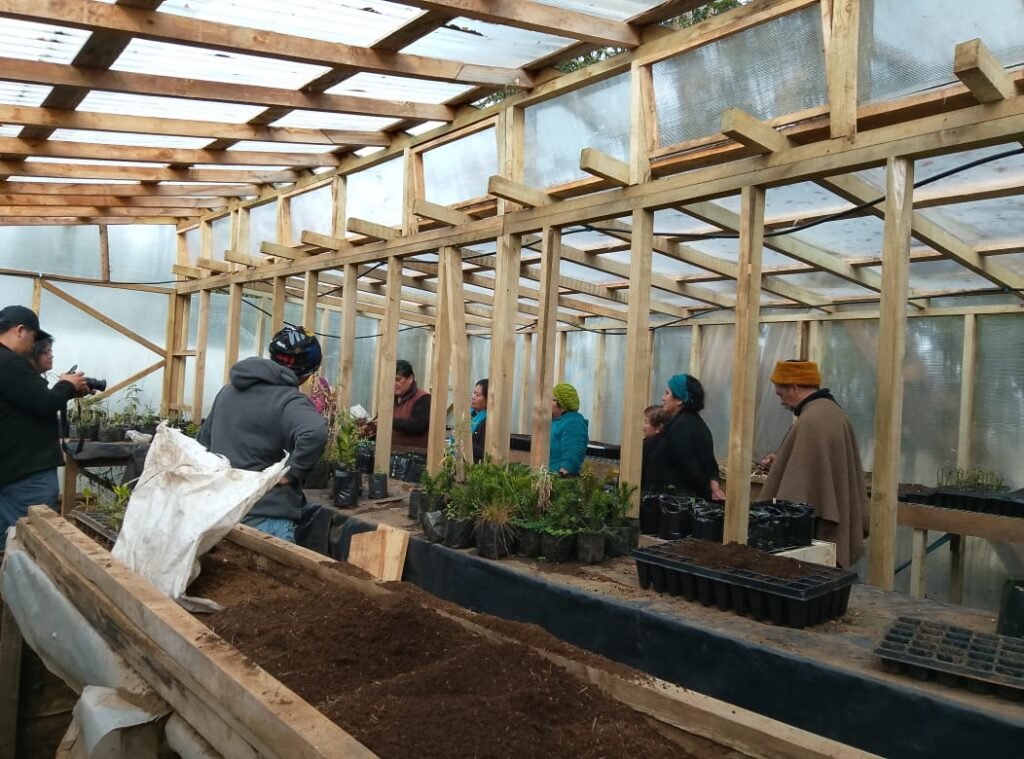
For Elizabeth Curiqueo, women are the protagonists of this initiative, without diminishing the contributions of men: “The gathering tradition comes from our mothers and grandmothers, who taught us to make use not only of the most well-known products, but also of the great diversity of fruits offered by the forest.”.
Curiqueo emphasizes that community life offers a fuller alternative to city life: “Living in the city was a form of survival, shaped by work conditions and quality of life. Here in the community there is always much to do, but we never lack anything. The tools we have gradually acquired not only help us produce oil, but also improve our quality of life. That has been fundamental.”
The enthusiasm around the hazelnut tree goes beyond commercialization: the women also prioritize internal consumption, strengthening local economies and food sovereignty. “That makes us very satisfied and happy,” Curiqueo adds.
Similarly, Óscar Carrillo highlights that the work with women seeks to ensure healthy, regenerative food for families while sharing these products with other territories: “The women are deeply committed to the community, to their work, and to sustaining a sustainable economy.”
Fabiola Painefil, administrator of the initiative, points to the diversity of products that can be made: “Hazelnut oil is something new for us, but we already knew hazelnut flour, which allows us to prepare healthier foods for children. During a learning exchange, we also discovered that hazelnut milk and even Nutella-style spreads can be made — products that are usually very expensive in supermarkets.”
This collective effort demonstrates that it is possible to create nutritious, accessible, and culturally rooted alternatives from what the forest provides, strengthening both the community and biodiversity.
Knowledge Transmission and Sustainability
Elizabeth Curiqueo explains that the sustainability of the initiative is based on the principles of the Lof’s self-governance: “Our principal ancestral authority is the lonko, together with the machis, elders, and grandparents. From that knowledge comes the guidance not to overextract, not to be extractivist, and to respect the diversity of fruits provided by the forest.”
This approach reflects a profound respect for nature and its cycles. “In this way, we avoid reproducing the extractivist business model that dominates the Chilean economy. It is ancestral knowledge and our relationship with the forest that differentiates us from other economies,” Curiqueo emphasizes.
In the same spirit, Fabiola Painefil stresses the importance of transmitting this legacy to younger generations: “It has been very enriching, as a woman and as a mother, to teach children about forest fruits, show them where they come from, and what products can be made from them. It has been a beautiful and meaningful experience.”
Through this work, the hazelnut initiative not only promotes a sustainable community economy, but also strengthens cultural memory and intergenerational ties with the land and its fruits.
More Than a Laboratory: Hazelnuts, Community Tourism, and Collective Well-Being
The experience of the hazelnut oil laboratory extends beyond production and commercialization: it has become intertwined with community tourism, where local entrepreneurs share with visitors the properties of the hazelnut tree and its oil. This expands the project’s reach while maintaining an economic circle that is close, fair, and accessible.
“Our economic circle is not far away. It is right here, with affordable prices for our people and for those who want to access these healthy products,” explains Elizabeth Curiqueo.
Within this vision, the initiative connects to a broader horizon of collective well-being in which regenerative food systems occupy a central place. “We have always believed that the foundation of family, life, health, and well-being lies in food — in how we eat and how we work the soil,” Elizabeth says.
As part of this effort, the community has been recovering traditional seeds and restoring the practice of consuming seasonal forest fruits, practices deeply tied to the worldview of the Mapuche people.
This commitment is also reflected in the exchange of knowledge. As Óscar Carrillo explains, the community work has made it possible to visit neighboring communities to share experiences regarding the uses and properties of hazelnuts, strengthening territorial networks and relationships.
Challenges and Future Vision
Elizabeth Curiqueo explains that one of the principal challenges is consolidating a community processing space for hazelnuts that serves all families. The goal is that, over the next seven years, fruit production — especially hazelnuts — will continue to increase and that more households will join this green movement of biocultural restoration.
The initiative also seeks to involve children and youth, transmitting knowledge about what they consume and promoting healthier, more conscious ways of living.
As Elizabeth reminds us, the hazelnut tree does not grow alone: it exists alongside a great diversity of life that feeds and coexists beneath its shade. Its fruits nourish, its leaves enrich compost, and its canopy shelters multiple species. The tree is an expression of Itxofilmogen, the diversity of life itself. For this reason, the challenge is not simply to plant trees, but to restore entire ecosystems that generate balanced and fertile spaces for life.